Planning a Concrete Driveway in Stratford? What to Know Before You Pour

A driveway is the first thing people see when they pull up to your house, and in Stratford it takes a beating. Freeze-thaw cycles from November to March, road salt tracked in from the street, a pickup or a trailer parked on it every night. If you're planning a new concrete driveway, the choices you make before the pour decide whether it still looks good in twenty years or starts cracking by the third spring.
This guide covers the decisions that matter most: whether concrete is right for your property, what a proper installation involves, how thick the slab should be, which finish to choose, what drives the price, and when the City of Stratford needs to approve the work. If you already know you want a new driveway, our concrete driveway installation page explains how we handle a job from tear-out to cure.
Is a Concrete Driveway Right for Your Property?
Most driveways in Stratford are asphalt, concrete or interlocking pavers. Concrete usually costs more to install than asphalt, but it doesn't need resealing every few years to stop it drying out and breaking up, it stays cooler and brighter in summer, and it gives you finish options asphalt can't match.
Concrete is usually the better fit when:
- You plan to stay in the home for years and want the driveway to last that long too.
- You'd like the driveway to match a new walkway, porch or patio.
- Heavy vehicles use it regularly, like a work truck, an RV or a trailer.
- You're on a rural lot in Perth County where the driveway also takes farm or equipment traffic near the house.
It's a tougher sell if you need the lowest possible upfront price, or if the ground has a drainage problem nobody plans to deal with. Concrete shows a weak base faster than any other surface.
How a Concrete Driveway Is Installed
The pour itself only takes a few hours. The work that decides how long your driveway lasts happens before the concrete truck shows up, which is why excavation and site preparation is most of the job.
- Tear-out. The old driveway is broken up and hauled away, along with any soft topsoil underneath.
- Excavation. The ground is dug down far enough for a gravel base and the slab. Soft or wet spots get dug out and replaced, not buried.
- Base. Crushed gravel goes in and is compacted in layers. A thin or loosely packed base is the most common reason driveways settle and crack.
- Forms and slope. Forms set the edges and the grade so water runs away from the garage, the house and your neighbour's yard.
- Reinforcement. If the plan calls for it, wire mesh or rebar is set on supports so it ends up inside the slab, not lying at the bottom.
- Pour and finish. The concrete is placed, levelled and given its final texture.
- Control joints. Grooves are cut or tooled into the slab so it cracks along straight, planned lines instead of randomly.
- Curing. The fresh concrete is protected while it gains strength over the next few weeks.
How Thick Should Your Driveway Be?
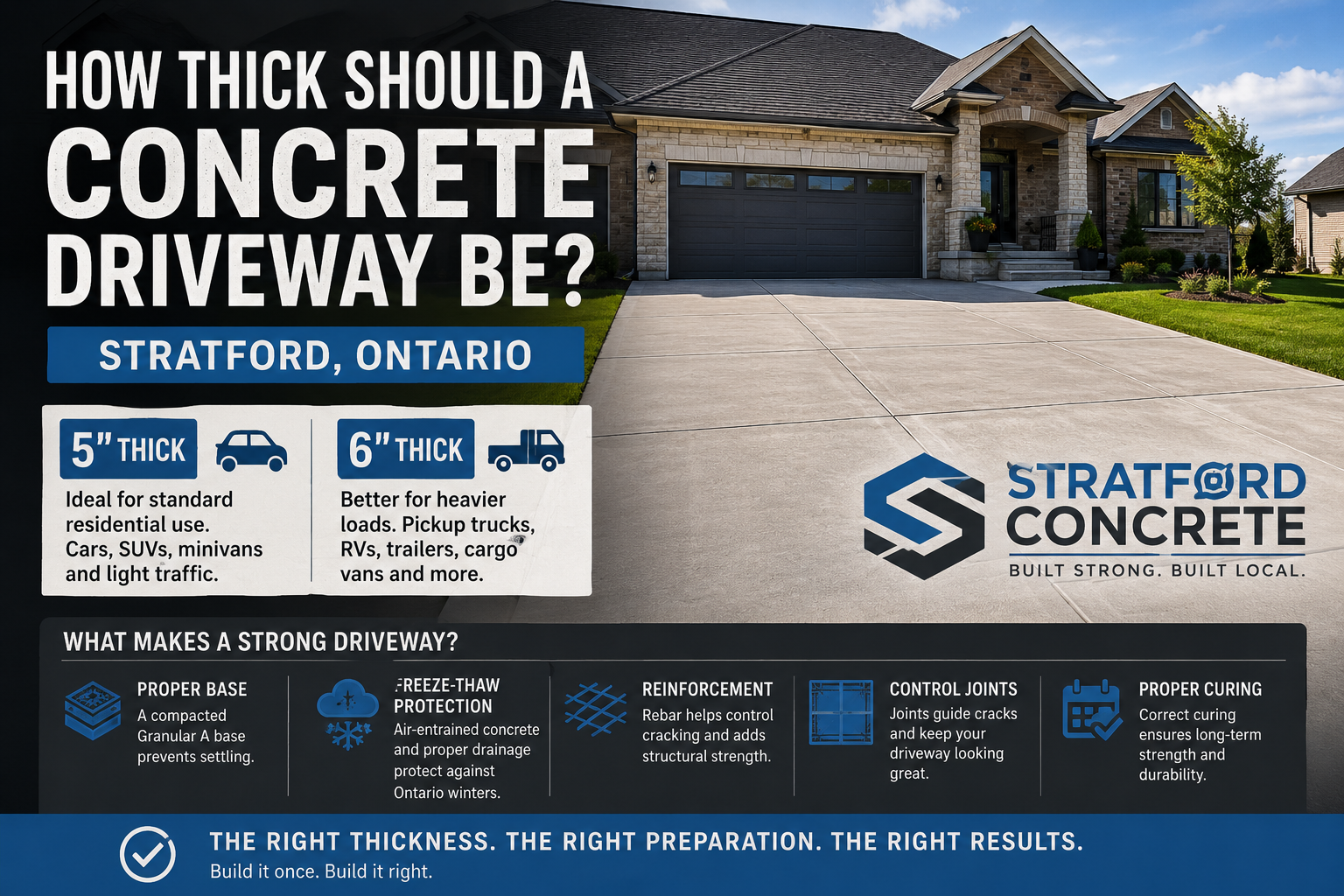
For a typical Stratford home with cars, SUVs and minivans, 5 inches of concrete is the usual standard. If a pickup, a cargo van, an RV or a loaded trailer will sit on it regularly, 6 inches gives you extra strength where you need it.
Thickness only helps if the base underneath is solid, though. A thick slab on poorly compacted ground will still sink and crack. Our article on how thick a concrete driveway should be in Stratford goes deeper into base depth, reinforcement and how control joints should be spaced.
Choosing a Driveway Finish
The finish affects how the driveway looks, how it handles ice and how much it costs. These are the three most homeowners choose between:
- Broom finish. A stiff broom dragged across the wet concrete leaves fine ridges that give tires and boots grip in winter. It's the most affordable option and the easiest to patch later.
- Exposed aggregate. The top layer of cement paste is washed off to show the stones in the mix. An exposed aggregate driveway is textured, slip-resistant and good at hiding dirt and tire marks.
- Stamped concrete. Patterns are pressed into the surface to look like stone, slate or brick, usually with colour added. A stamped concrete driveway costs more and can be smoother underfoot, so the texture and sealer matter on a sloped driveway.
Plenty of homeowners mix them, for example a broom-finished driveway with a stamped border, or a plain driveway that leads to a decorative front walk.
Widening or Adding a Driveway in Stratford
A second parking spot is one of the most common reasons people call about a concrete driveway extension. In the City of Stratford, widening an existing driveway or adding a new one needs a driveway permit before any work starts, and the application asks whether a curb cut is needed.
The zoning by-law also limits how wide a residential driveway can be. Under the City's Zoning By-law 10-2022, it's the lesser of 8 metres or half the width of your lot along the street. On a narrow lot, half the frontage can be the tighter limit, so measure before you plan a double-wide.
You can download the City's driveway permit application from its website. Doing the work without approval can mean fines, so sort out the permit before you sign a contract. If you live outside city limits, in Perth East, West Perth or another township, the rules come from your township office instead.
What Affects the Cost of a Concrete Driveway
Quotes vary, but every concrete driveway price comes down to the same handful of factors:
- Size and layout. More square footage, curves and turnaround areas mean more forming, concrete and labour.
- Removing the old driveway. Breaking out and disposing of old asphalt or concrete is a real cost.
- Base and drainage. Clay soil, low spots or a slope toward the house all mean more digging and more gravel.
- Thickness and reinforcement. A 6-inch slab and added steel cost more, and they're worth it where heavy vehicles park.
- Finish. Broom is the baseline; exposed aggregate and stamped finishes add time and materials.
- Access and permits. Tight access, curb cuts and City permits all add to the total.
When you compare quotes, compare the excavation depth, base thickness and slab thickness before the bottom line. That's usually where a cheaper price is coming from.
Replace or Repair Your Old Driveway?
Not every cracked driveway needs to go. Thin hairline cracks are normal as concrete shrinks and are mostly cosmetic. A slab that has sunk, heaved or broken into pieces usually means the base has failed, and patching the surface won't fix that.
If most of the driveway is breaking up, concrete driveway replacement is usually the better long-term spend. If the damage is limited to one section, an edge or the front steps, our concrete repair and replacement service may save you the cost of a full tear-out.
Timing, Curing and Your First Stratford Winter
Most driveway work in Stratford happens from spring through late fall. Concrete can be poured in cold weather with insulated blankets and careful timing, but it adds cost and risk, so most homeowners book driveway projects for the warmer months.
After the pour, you can usually walk on the new concrete in a day or two and drive on it after about a week. It keeps gaining strength for around a month, and your contractor should give you exact timing based on the weather and the mix.
Go easy on it during the first winter. Use a plastic shovel, don't chip at ice, and skip de-icing salt on a brand-new driveway. Sand gives you grip without damaging fresh concrete. Many homeowners also apply a penetrating sealer once the concrete has fully cured to help keep water and salt out over the years.
Questions to Ask Before You Hire a Contractor
These questions quickly separate a careful quote from a vague one:
- How deep will you dig, and how much compacted gravel goes under the slab?
- How thick will the concrete be, and is it thicker where trucks or trailers park?
- Is reinforcement included, and how will it be held in place inside the slab?
- Where will the control joints go?
- How will water drain away from the house and garage?
- Who applies for the City permit if the driveway is getting wider or the curb is being cut?
- Does the price include removing the old driveway, disposal and cleanup?
A contractor who answers these in writing has thought about your driveway, not just your square footage.
Frequently Asked Questions
How long does a concrete driveway last in Stratford?
With a well-compacted base, good drainage and sensible care in the first winter, a concrete driveway can last for decades. When one fails early, the cause is usually underneath: a thin or poorly drained base, not the concrete itself.
Do I need a permit to widen my driveway in Stratford?
Yes. The City of Stratford requires a driveway permit to widen an existing driveway or add a new one, and work can't start until the permit is issued. The zoning by-law caps residential driveway width at 8 metres or half the lot frontage, whichever is less.
How soon can I drive on a new concrete driveway?
Usually after about a week, depending on the temperature and the mix. Walking on it is typically fine after a day or two.
Can a concrete driveway be poured in winter?
It can, with insulated blankets and careful timing, but cold weather adds cost and risk. Most Stratford driveway projects are scheduled between spring and late fall.
Is concrete better than asphalt for a driveway?
It depends on your budget and how long you'll stay. Asphalt costs less up front but needs regular resealing. Concrete costs more to install, needs less routine maintenance and gives you more finish options.
Planning a Driveway in Stratford?
Stratford Concrete installs and replaces driveways across Stratford, St. Marys, Mitchell, Tavistock, Shakespeare, Sebringville and the rest of Perth County. We look at the soil, the drainage and how you use the driveway before we recommend anything, and you get a clear written quote before work starts. Request a free estimate to get started.
You might also like